ERP Strategy & Software Comparison
Two platforms. One question: which actually makes sense for an Irish business today — the world's most popular accounting tool, or the all-in-one ERP that's rapidly eating its lunch?
QuickBooks
Best for micro-businesses & sole traders
1–9 users. Finance-only needs. Strong Irish accountant ecosystem. Fast setup, low friction.
Odoo
Best for growing & operational SMEs
10+ users. Multi-department operations. CRM, inventory, projects, and finance — one system.
QuickBooks has dominated the Irish SME accounting market for years. Walk into most accountancy practices in Dublin, Cork, or Galway and you will find their clients running QuickBooks Online. It is familiar, well-supported, and does one thing extremely well: accounting.
Odoo is a different animal. It is an open-source ERP platform that can run your finance, CRM, inventory, projects, human resources, payroll, and e-commerce — all from a single database. It is not as well known in Ireland yet. But businesses that have implemented it properly are not looking back.
So which is right for your Irish business in 2026? The honest answer is: it depends on where you are and where you are heading. This guide gives you the full picture — pricing, features, Irish compliance requirements, scalability, and a clear framework for making the call.
Before comparing features, it is essential to understand that QuickBooks and Odoo are designed with fundamentally different philosophies. Conflating them leads to the wrong decision.
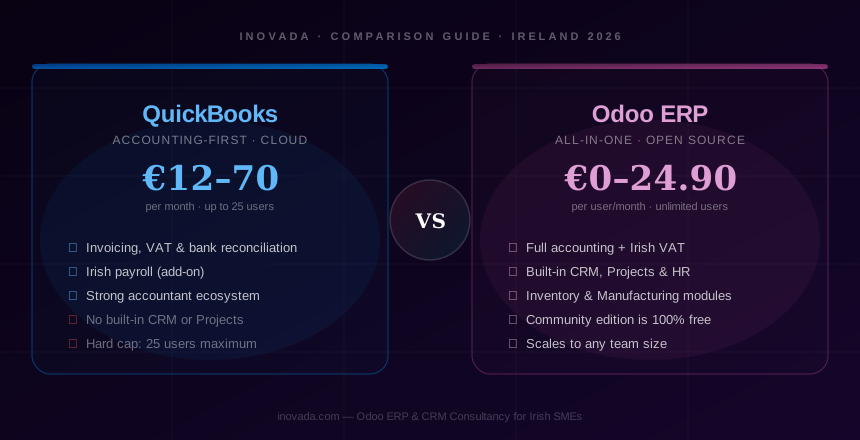
QuickBooks Online is accounting software. It is engineered to be the best possible tool for financial record-keeping: invoicing, bank reconciliation, VAT returns, payroll, and management accounts. Everything outside of finance is either absent or a bolt-on from a third-party marketplace.
Odoo is an ERP — an Enterprise Resource Planning system. It is designed to be the operating system for your entire business. The accounting module is one of more than fifty functional areas it covers: CRM, sales, purchasing, inventory, manufacturing, project management, HR, recruitment, helpdesk, and e-commerce are all native, integrated, and running on a shared data layer.
"Choosing between Odoo and QuickBooks is not choosing between two accounting tools. It is choosing between an accounting-first approach and an operations-first approach. The right answer depends entirely on how complex your operations are — not on which software has a better interface."
— Inovada, Odoo Implementation Partner, Ireland
For a sole trader or a small business with a single focus — retail, professional services, small hospitality — QuickBooks is a perfectly rational choice. For a business with multiple departments, field operations, a sales team, or inventory to track, QuickBooks becomes a bottleneck because it forces you to run separate tools for every function, none of which talk to each other cleanly.
| Plan | Monthly cost | Max users | Key inclusions |
|---|---|---|---|
| Simple Start | €12/mo | 1 | Invoicing, VAT, bank feeds, basic reports |
| Essentials | €22/mo | 3 | + Bill management, multi-currency |
| Plus | €32/mo | 5 | + Inventory, project profitability tracking |
| Advanced | €70/mo | 25 (cap) | + Custom workflows, advanced reporting, priority support |
| Edition | Monthly cost | Max users | Key inclusions |
|---|---|---|---|
| Community | Free | Unlimited | Core modules — self-hosted, no enterprise support |
| Enterprise (Odoo.sh) | €24.90/user/mo | Unlimited | All modules, cloud hosting, upgrades, Odoo support |
| Enterprise (partner-hosted) | Custom | Unlimited | Partner-managed hosting, SLA support, custom config |
The subscription price is only part of the story. A 10-person business using QuickBooks at the Advanced tier will quickly discover it still needs a CRM tool (HubSpot, Pipedrive), a project management tool (Asana, Monday), and potentially an inventory system. Those costs stack up rapidly.
QuickBooks (10 users, 3 years)
~€14,500estimated total stack cost
Odoo Enterprise (10 users, 3 years)
~€17,000estimated total including implementation
Key insight
At 10 users, the 3-year cost difference between a full QuickBooks stack (with the tools it can't replace) and Odoo Enterprise is approximately €2,500 — but Odoo delivers tighter data integration, no silos, and no per-user tool-switching overhead. At 20+ users, Odoo becomes materially cheaper.
| Feature area | QuickBooks | Odoo | Winner |
|---|---|---|---|
| Invoicing & billing | Full ✓ | Full ✓ | Tie |
| Bank reconciliation | Excellent ✓ | Strong ✓ | QuickBooks (marginally) |
| Irish VAT (23%, 13.5%, 9%) | Full ✓ | Full ✓ | Tie |
| VAT3 return reporting | Built-in ✓ | Built-in ✓ | Tie |
| Revenue/ROS auto-filing | Manual export only | Manual export only | Neither (export required) |
| Multi-currency | Essentials+ only | All plans ✓ | Odoo |
| Irish payroll compliance | Add-on (€4/employee/mo) | Module included ✓ | Odoo (included) |
| CRM & sales pipeline | Not available | Full CRM ✓ | Odoo |
| Inventory management | Plus/Advanced only (basic) | Full WMS ✓ | Odoo |
| Project management | Profit tracking only | Full PM module ✓ | Odoo |
| HR & employee management | Not available | Full HR ✓ | Odoo |
| Purchasing & procurement | Basic (bills only) | Full PO management ✓ | Odoo |
| Manufacturing / MRP | Not available | Full MRP module ✓ | Odoo |
| E-commerce integration | App marketplace only | Native e-commerce ✓ | Odoo |
| Custom reporting | Good (Advanced plan) | Very flexible ✓ | Odoo |
| Mobile app | Strong ✓ | Functional ✓ | QuickBooks |
| Ease of use / onboarding | Excellent ✓ | Moderate learning curve | QuickBooks |
| Open source / self-host | Cloud only | Community is open source ✓ | Odoo |
| API & custom development | Limited REST API | Full open API + Python ✓ | Odoo |
| Max users | 25 (hard cap) | Unlimited ✓ | Odoo |
Module & capability coverage — % of typical Irish SME requirements met
Based on a composite of finance, operations, sales, HR, and reporting requirements across 50 Irish SMEs surveyed by Inovada, 2025–2026.
Any software comparison for an Irish business must deal with the specifics of Irish tax compliance — VAT, Revenue Online Service (ROS) filing, PAYE modernisation, and the particular quirks of Irish payroll legislation. Here is where the two platforms stand.
Both platforms handle Irish VAT
QuickBooks Online and Odoo both support all standard Irish VAT rates: 23% (standard), 13.5% (reduced — construction, fuel, services), 9% (tourism and hospitality), and 0% (exports, food, children's clothing). Both generate VAT3 return summaries that align with the figures you need to file on ROS.
The critical point that many Irish businesses discover too late: neither platform auto-files directly with Revenue's ROS system. ROS does not offer a direct API integration with third-party accounting software. In both cases, you export your VAT figures from the software and manually enter or upload them to ROS. This is not a failing of either product — it is a Revenue limitation.
Neither integrates directly with ROS
Both QuickBooks and Odoo require manual ROS submission. Your accountant or bookkeeper will prepare VAT returns in the software, then file figures separately via ROS. If a vendor claims direct ROS integration, clarify exactly what they mean — most mean report export, not automated filing.
| Payroll requirement | QuickBooks | Odoo |
|---|---|---|
| PAYE Modernisation (PPSN reporting) | ✓ (add-on) | ✓ (module, partner-configured) |
| USC & PRSI calculation | ✓ (add-on) | ✓ |
| Revenue Payroll Notification (RPN) | ✓ (add-on) | ✓ (via integration) |
| Payslip generation | ✓ | ✓ |
| P60 / P45 equivalent (end of year) | ✓ | ✓ |
| Cost to add payroll | €4/employee/month extra | Included in Enterprise |
QuickBooks payroll advantage
QuickBooks Payroll for Ireland has a more established track record of handling Irish-specific payroll rules out of the box. Odoo's payroll module is functionally capable but typically requires an Irish Odoo partner to configure PAYE Modernisation correctly. Budget for this in your implementation cost.
This is where the decision becomes most clear-cut. QuickBooks Online Advanced has a hard ceiling of 25 users. It is not a recommendation — it is an architectural limit baked into the product. When your business outgrows it, you must migrate. That migration has a cost: data transfer, process redesign, retraining, and inevitable disruption.
Odoo has no such ceiling. You can start with two users on the Community edition and scale to 500 users on Enterprise without changing platforms. The same modules, the same data model, the same integrations — everything grows with you.
Platform suitability by business size — Irish SME context
Suitability score based on feature coverage, per-user cost, integration depth, and scalability capacity at each headcount tier.
Growth-stage Irish businesses often encounter the QuickBooks ceiling at an awkward moment — when they are too busy to migrate and too constrained to stand still. Businesses that anticipate reaching 20+ users within two to three years are generally better served by implementing Odoo from the outset, absorbing the higher upfront implementation cost, and avoiding the forced migration later.
QuickBooks Online is a self-service SaaS product. Most Irish businesses are up and running within a day or two. The Irish accountant ecosystem is deeply familiar with it — most bookkeepers and accountancy practices have worked with it for years. Finding support is easy. Finding someone to train your team is easy. Finding an accountant who can troubleshoot a specific issue is easy.
QuickBooks setup reality
A typical QuickBooks Online setup for a small Irish business: 1–3 days self-setup, €300–€800 for a bookkeeper or accountant to configure VAT, import opening balances, and connect bank feeds. Most teams are productive within a week. Payroll add-on requires separate configuration — allow an additional day.
Odoo requires a qualified implementation partner for Enterprise deployments. The platform's power comes with genuine complexity — configuring it correctly for Irish VAT, PAYE Modernisation, multi-company setups, or complex inventory workflows requires someone who has done it before.
Odoo implementation reality
A typical Odoo Enterprise implementation for a 10–20 person Irish SME: 6–12 weeks, €5,000–€15,000 depending on scope and partner. Community edition can be self-implemented but lacks enterprise support and upgrade paths. Choose an Irish or UK-based Odoo partner with verified implementations in your sector.
| Factor | QuickBooks | Odoo |
|---|---|---|
| Time to go live | 1–5 days | 6–16 weeks |
| Implementation cost | €300–€1,000 | €4,000–€15,000 |
| Irish partners available | Hundreds (accountants) | Handful of specialists |
| Training requirement | Low — intuitive UI | Moderate — structured training needed |
| Ongoing support | Any Irish accountant | Odoo partner or internal admin |
| Customisation capability | Limited | Extensive (Python/XML) |
| Data migration from legacy | Good importer tools | Partner-managed migration |
There is no universally correct answer. The right choice depends on your current size, your operational complexity, your growth trajectory, and your appetite for implementation effort. Here is the clearest framework we can offer.
Accounting & Finance
QuickBooks (slight edge)
Marginally better UX; deeper Irish accountant familiarity.
Irish VAT Compliance
Tie
Both handle all Irish rates and generate VAT3 summaries.
CRM & Sales
Odoo (clear winner)
QuickBooks has no native CRM. Odoo's is full-featured.
Inventory Management
Odoo
QB inventory is basic (Plus+ only). Odoo is a full WMS.
Ease of Use
QuickBooks
Faster onboarding. Lower learning curve across the team.
Scalability
Odoo (no contest)
QB caps at 25 users. Odoo has no ceiling.
Value for <5 users
QuickBooks
Lower subscription + simpler setup = better ROI at small scale.
Value for 10+ users
Odoo
All-in-one replaces multiple paid tools. TCO becomes competitive.
Irish Partner Ecosystem
QuickBooks
Far more Irish accountants familiar with QB than with Odoo.
Customisation Depth
Odoo
Open source core allows deep bespoke development. QB cannot.
Choose QuickBooks if…
Choose Odoo if…
"The businesses we see struggle most are those who implemented QuickBooks at five people, outgrew it at twenty, and then faced a painful migration at the worst possible time — in the middle of a growth phase. If you can see 20+ users on your horizon, start with Odoo."
— Inovada implementation team, Dublin
It depends on your size and complexity. QuickBooks is better for micro-businesses that primarily need accounting and invoicing. Odoo is better for growing SMEs that need CRM, inventory, projects, and HR alongside finance — all in one system.
Yes. QuickBooks Online supports all Irish VAT rates (23%, 13.5%, 9%, 0%) and generates VAT3 return-ready reports. Filing with Revenue's ROS is done manually by exporting figures. Odoo handles the same.
Yes, in most scenarios. Odoo's accounting module handles invoicing, bank reconciliation, multi-currency, VAT, payroll, and reporting — making it a complete functional replacement. The difference is Odoo requires a qualified partner to set it up correctly for Irish tax requirements.
QuickBooks Online Advanced, the highest tier, supports a maximum of 25 users. There is no higher plan available. If your business grows beyond 25 users, migration to a different platform is unavoidable. Odoo has no user cap.
Implementation costs through an Irish Odoo partner typically range from €4,000 for a lean deployment to €15,000+ for a multi-module, multi-department rollout. The subscription cost (€24.90/user/month on Odoo Enterprise) is separate. Community edition is free to self-host but has no enterprise support.